 By
By 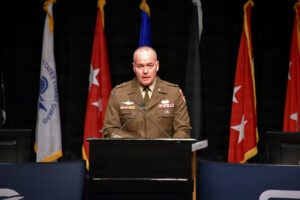
HUNTSVILLE, Ala. – The head of the Army’s Space and Missile Defense Command on Tuesday said the Army needs a “comprehensive missile defeat strategy” that goes beyond just adding more interceptor numbers.
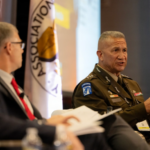
“We need a more comprehensive missile defeat strategy that focuses on interceptors [and] equally so on non-kinetic effects, both electronic warfare and directed energy, and the type of targeting in [command and control] enabled by that data strategy, and a cross-domain solution … that will enable us to use that data to make decisions to engage targets faster,” Lt. Gen. John Rafferty, commanding general of U.S. Army Space and Missile Defense Command, said here during an opening keynote at the annual Space and Missile Defense Symposium.
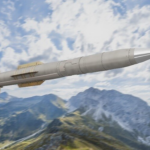
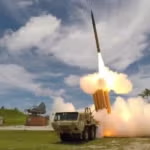
Adding more Patriot Advanced Capability (PAC)-3 and Terminal High Altitude Area Defense (THAAD) interceptors alone will not be enough to solve all the problems, because this “comprehensive missile defeat strategy that isn’t just about more interceptors. It’s about integrating other capabilities, non-kinetics, and also decision making into them,” Rafferty added.
Rafferty also admitted he cannot add more to emphasize the need for magazine depth “or for the need for cheaper and a wide-ranging mix of interceptors. That couldn’t be made more loud and clear from the highest levels of our government.”
He later told reporters during a roundtable that this strategy is conceptual right now and has not yet made it into doctrine yet, but thinks it has always been in tactics, techniques, and procedures (TTP).
“Combined arms is really a comprehensive enemy defeat strategy, right? So looking at ways to bring multiple effectors from multiple domains against an adversary target or system is a comprehensive approach to it,” Rafferty said.
Rafferty told reporters that while this concept is generating some interest in the Army, “from my standpoint, it’s really a riff on integrated offensive and defensive fires. And that is defeating the arrow and killing the archer.”
He argued that actually integrating the systems into a strategy will be hard, but they should keep the overall approach conceptually simple.
“I think in terms of TTP and how we would want to fight with it, I think it’s trying to keep it as simple, as integrated offensive and defensive fires, is about as complicated as we need to talk about it, right? The actual doing it is going to be hard, but if we keep the approach simple, we can do it,” Rafferty said.