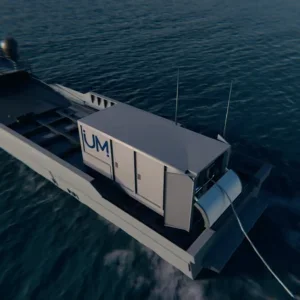

BAE Deck Launcher. BAE Systems performed the first live-fire test of its Adaptable Deck Launcher (ADL) missile launching solutions that aims to increase the combat capability and adaptability across the U.S. Navy and allied forces, the company said on Oct. 27. ADL was developed under a DoD contract for the NATO Seasparrow Project Office (NSPO) and is designed to provide the reliability of a Vertical Launching System (VLS) and low-cost operation by using an existing Mk 41 VLS logistics and electronics suite. The ADL specifically was developed by the Mk 41 VLS mechanical design agent for full compatibility with the Evolved SeaSparrow Missile Mk 25 Quad-Pack canisters, “which provide surface-to-air defense for ships against supersonic anti-ship missiles, aircraft and other aerial threats,” BAE said in a statement. The company said ADL can provide anti-air defense to aircraft carriers, amphibious ships and other surface combatants and can come in a compact configuration that it called “ideal for medium unmanned surface vessels.”
Integrate WDCs. Chief of Naval Operations Adm. Daryl Caudle on Oct. 26 said he plans to better integrate the Navy’s warfighting development centers horizontally. He said while the Undersea Warfare Development Centers are “world class at creating the approach and attack manual for a submarine skipper,” they are not great at working with other kinds of development centers. Caudle said the Navy Warfighting Development Center (NWDC) has been “kind of pigeonholed …to being kind of the person who was basically owning the [Maritime Operations Center, MOC] standard and the MOC cert in some of the live virtual constructive integration,” but they should have been integrating across development center. “I’m probably going to give that NWDC an OPNAV N7 hat to be the, no kidding, echelon one integrator of our warfighting development centers to make them talk horizontally.”
Saab’s Ocean Barrier. Saab on Oct. 28 launched its new Ocean Barrier integrated scalable underwater surveillance solution designed for persistent maritime awareness that can protect critical infrastructure, coastal areas and territorial waters from underwater threats. Saab said Ocean Barrier works by agnostically integrating sensors, data collection and operator capabilities into a single connected system and converting sensor information into real-time situational awareness that “helps its operators understand what is happening below the surface and respond to potential threats with confidence.” The system provides three defensive perimeters: detect, prevent and protect, which can all be tailored in different operational environments and operate independently or as part of a larger integrated system. Saab said this means Ocean Barrier can protect an individual harbor or naval base as well as national waters and coastlines.
SSN-788. The Virginia-class fast-attack submarine USS Colorado (SSN-788) arrived at HMAS Stirling on Oct. 27 to start a scheduled month-long maintenance period, the fourth such submarine maintenance period in the region since AUKUS was established. This came days after the Pentagon announced SSN-788 will be the first American Virginia-class submarine assigned to Submarine Squadron 3, helping establish the Submarine Rotation Force-West (SRF-West) at HMAS Stirling. After this maintenance period ends and it sails away, the Colorado is scheduled to return to HMAS Stirling to start the new posting in late 2027. Under SRF-West, up to four U.S. attack submarines and one U.K. Royal Navy submarine will rotationally operate out of Stirling.
Cyprus Gets Israeli OPV. The Israel Ministry of Defense (IMOD) and the Cyprus Ministry of Defense on Oct. 26 signed an agreement for the latter to acquire a new Offshore Patrol Vessel (OPV). Under the agreement, Israel will supply Cyprus with a new patrol vessel built by Israel Shipyards and fitted with a range of Rafael naval systems. Concurrently, the systems aboard Cyprus’s existing Israel Shipyards-built patrol vessel will also be upgraded. IMOD said the new Cyprus OPV alongside the current to-be-upgraded OPV Ionnides will allow expanded patrol, surveillance, and search-and-rescue missions.
USV MCM $$. AEVEX Corp. last week said its Maritime Systems division was awarded two contracts by the Navy’s Portfolio Acquisition Executive Robotic and Autonomous Systems for $41.6 million to build, field and operate the SightGlass and Fisher mine countermeasures (MCM) small unmanned surface vessels (USVs). The SightGlass award is $15.6 million and Fisher $26 million. The autonomy and unmanned systems company said the awards stem from it being one of the winners in the Defense Innovation Unit’s MCM Challenge, and previous work integrating MCM capabilities with its Global Autonomous Reconnaissance Craft fleet at the start of Operation Epic Fury (Defense Daily, Oct. 1).
Saildrone in Sweden. Saildrone is operating four of its Voyager unmanned surface vessels in the Baltic Sea to help Sweden’s navy with maritime domain awareness operations. The one-year mission is the first deployment under the Nordic Defence Cooperation framework that also includes Denmark, Finland, Iceland and Norway, and gives these countries “a common mechanism for procuring long-endurance maritime surveillance services,” the California-based company said. The use of the Voyagers is a response to growing “gray zone” operations, typically carried out by Russia, in the Baltic Sea such as disabling undersea infrastructure. It is also an effort to integrate unmanned assets into allied operations.
Shield-RTX Partnership. Shield AI Head of Aircraft Armor Harris posted on LinkedIn that his company is working with RTX’s Raytheon segment to leverage the legacy defense contractor’s heritage and expertise in mission systems for the X-BAT vertical takeoff and landing fighter jet. “We are working with Rayton on breaking the cost curve of the 6th gen mission systems to install them on X-Bat, which would make X-BAT the Apex predator of unmanned systems,” he wrote. “We’re working with Raytheon’s Advanced Technology team on the radio frequency (RF) sensing and electronic warfare systems it needs to find targets and survive in contested airspace. More to come.”
… International Hivemind. Shield last week said its Hivemind autonomy piloting software will be integrated with Leonardo’s Proteus uncrewed aircraft. Shield is providing the Italian defense company with a software development kit that expands Leonardo’s ability to build its own mission autonomy software. Separately, Shield signed a memorandum of understanding with Barzan Holdings Joint Venture RBAT to explore integrating Hivemind into Qatari-designed maritime autonomous defense and security solutions.
New Strike Drone. First Breach, Inc., a manufacturer of ammunition and developer of drones, has completed the first test flight of its Group 1 Long Range Strike quadcopter platform, which has a range exceeding 20 kilometers and a 2.2-pound payload capacity. The publicly traded, Maryland-based company also has a Close Quarters Strike drone in flight testing. First Breach is partnered with Pittsburgh-based Hellbender, which makes artificial intelligence-based cameras and offers turnkey manufacturing solutions.
New Directed Energy Weapon. Laser Photonics Corporation, which is developing directed energy weapons for defense and laser technologies for industrial applications, has launched the Quantum Bullet counter-drone platform. The product line includes the Laser Shield Anti-Drone modular directed energy platform that can be offered with different laser and power capabilities. Options include a dazzler configuration to interfere with optical sensors on Groups 1 and 2 drones, and two higher energy laser versions designed to destroy small drones, palletized variant and another with a “crawler module” for use in all-terrains.
SOCOM AI Award. Smack Technologies, which builds domain specific artificial intelligence models to improve decision making, has received a $7.5 million award from U.S. Special Operations Command (SOCOM) to provide its Omega AI decision platform for commanders. “Winning the next peer-level conflict will require the ability to rapidly fuse and reason over multimodal data to make informed decisions across echelons and time horizons, which is a capability that does not exist today,” Any Markoff, co-founder and CEO of the Texas-based company, said in a statement. Smack said the Other Transaction Agreement is part of the command’s initiative to apply frontier AI models into deployable warfighting capabilities.
XQ-67A. The Air Force Research Laboratory and Air Combat Command’s Experimental Operations Unit recently flew the General Atomics Aeronautical Systems Inc. (GA-ASI) XQ-67A Autonomous Collaborative Platform (ACP) at the Nevada Test and Training Range to accelerate ACP under the Demonstration of ACP Performance and Effectiveness (Demon APE) project, the Air Force said. GA-ASI has said that the XQ-67A was a basis for the company’s YFQ-42, now testing out under the service’s Collaborative Combat Aircraft program. During the recent XQ-67A flight, the drone “demonstrated integration of several advanced mission systems including state-of-the-art sensors, mission computers and power and thermal management hardware, all designed to work collaboratively in demanding combat environments,” the Air Force said. “Additionally, the integration of Beyond Line-of-Sight datalinks and live, virtual and constructive simulations during the flight demonstrated management of uncrewed platforms across distributed theaters, bolstering deterrence through resilient, layered command and control.”
412th Reorganization. Air Force Col. Tom Tauer, the commander of the Air Force 412th Test Wing at Edwards AFB, Calif., said that he is overseeing a reorganization of the wing, including putting the Test Management Division under Col. Clifton Bell, the commander of the 412th Operations Group, to focus on high-priority tests. Tauer also “praised the 461st Flight Test Squadron for rapid delivery of war-winning capability in response to real-world combat needs,” according to the 412th Testing Wing. “During Operation Epic Fury, the Airpower Foundations Integrated Test Force (ITF) executed tests to determine if the F-35 Lightning II could effectively deploy munitions at supersonic speeds. In six weeks, the ITF provided results that changed real-time combat tactics, maximized platform lethality and elevated pilot survivability.”
DE for ISV. The Army on Oct. 27 released a Request for Solutions, through the National Security Technology Accelerator (NSTXL), to assess industry’s concepts for reducing the Size, Weight, and Power (SWaP) of high-energy lasers (HEL) intended to be integrated on the Infantry Squad Vehicle-Utility platform. “[Directed Energy] enhancements will seek innovative approaches to develop solutions that reduce SWaP parameters for an Infantry Squad Vehicle–Utility-based, 30kW-class HEL weapon system to support the Army’s acquisition decision in Fiscal Year 2031,” the NSTXL notice states. The ISV-U is built by GM Defense and the Army recently selected AeroVironment to deliver its 30-kilowatt LOCUST X3 laser weapon system for the Enduring-HEL requirement, which the company described as the “first-ever production contract for directed energy systems in United States history.”
Magnet Production. Evolution Metals & Technologies Corp. (EM&T) said on October 28 it responded to the Army’s call seeking companies that could manufacture rare earth magnets to support the service’s production of brushless motors for small drones, noting it currently produces N42SH magnets at its facility in Pohang, South Korea. “We already make N42SH commercially, we know how to qualify grades for demanding customers, and we are scaling to approximately 10,000 metric tons in Pohang. We are prepared to work with the Army on qualification and to establish a secure, traceable domestic supply chain for drone magnets. We are certified and going into commercial production of seven additional grades representing 52 percent of the total sintered market globally by revenue,” Andrew Knaggs, president of EM&T, said in a statement. The Army has said it plans to potentially make “multiple awards” for the magnet production work.
UGV Autonomy. Off-road autonomy firm Mach said on Oct. 23 that HDT Robotics, now known as BLADE, has selected the company to be the autonomy technology partner for its work on the Army’s Infantry Last Tactical Mile (ILTM) program. BLADE was one of six companies picked to deliver prototypes for the ILTM effort, and will deliver its Hunter WOLF 6×6 hybrid-electric uncrewed ground vehicle. “Under the prototype award to BLADE, Mach provides the onboard autonomy software, rugged edge compute, and multi-modal sensor architecture that allows the Hunter WOLF to perceive, navigate and execute missions beyond the operator’s line of sight. Mach will support BLADE through upcoming Army demonstrations and a soldier-led operational assessment scheduled for early 2027, which will inform the Army’s production decision for next-generation autonomous infantry systems,” Mach said in a statement.
GDIT/Vion. General Dynamics Information Technology said on Oct. 29 it recently conducted a successful demonstration of its Vion Mission Partner Environment solution during the Pacific-based Olympus Fires 2026 military exercise. “Built with live AI-backed language translation, advanced voice, video, chat and email collaboration tools, and AI-assisted software development capabilities, Vion enables warfighters to quickly share and visualize intelligence and threat data – all protected by advanced zero trust cyber security,” GDIT said in a statement. “In austere environments, coalition forces can activate Vion to coordinate strikes against fortified targets by processing data at the edge. In joint all-domain operations, Vion can ingest and interpret all types of data from any coalition partner, including drone surveillance, maritime sensors and satellite imagery into a single battlespace display so every partner can access the same intelligence in real time.”
Apache Support. The Army on Oct. 27 awarded Boeing a nearly $500 million contract modification to continue engineering services and technical support for its AH-64 Apache attack helicopters. The award will continue work on the support contract through Feb. 20, 2031, according to the Pentagon.
Thermal Sensing. Night vision manufacturer Deepnight announced on Oct. 28 it has received an Other Transaction Authority agreement from the Army for the Delivering Unmatched Thermal Capability Hastened (DUTCH) program to work on developing its “proprietary AI imaging platform for thermal sensing, extending the platform beyond its current low-light imaging work into a new sensor modality.” “As the Army scales attritable, mass-produced drone fleets, equipping every unit with high-performance thermal sensors has been cost-prohibitive using current hardware. Today’s leading thermal sensors can cost several thousand dollars per unit, which is a price point that makes outfitting large, expendable-by design fleets economically unworkable at scale,” Deepnight said in a statement. “Under the DUTCH program, Deepnight’s proprietary AI imaging platform will be integrated with lower cost thermal sensor hardware, using the company’s neural network-based image processing to deliver performance approaching that of far more expensive thermal systems. The goal of the program is to move high-performance thermal sensing from a premium capability to one that can be manufactured and fielded at scale, at a fraction of today’s typical cost.”
Reconciliation Obligation. The Pentagon confirmed on Oct. 28 it has officially obligated 97.5 percent of the defense funds included in last year’s One Big Beautiful Bill Act (OBBBA) before the end of fiscal year 2026. Of the $152.4 billion authorized for the Pentagon in the OBBBA reconciliation bill, the Pentagon said it’s allocated $148.5 billion to date. “Following communications with Congress, the department chose to reserve portions of funding provided to the Office of Strategic Capital (OSC), the Defense Innovation Unit (DIU), and the Economic Defense Unit (EDU) to preserve investment options into Fiscal Year 2027 and maximize use of those dollars,” DoD Comptroller Jay Hurst said in a statement.
Military Intel Budget. The Pentagon on Oct. 30 confirmed that its Military Intelligence Program’s (MIP) budget topline for fiscal year 2026 was $30.9 billion. The department disclosed no further details, besides noting the spend figure is “aligned to the National Defense Strategy.” “The Department determined that releasing this top line figure does not jeopardize any classified activities within the MIP. No other MIP budget figures or program details will be released, as they remain classified for national security reasons,” the Pentagon said in a statement.
Leidos Boosts Dividend. Leidos on Friday said its board has approved a quarterly cash dividend of 45 cents per share, a two percent hike over the current payment to shareholders. The dividend is payable on Dec. 31.