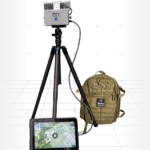

C-UAS Advice. The challenges associated with detecting an unmanned aircraft system (UAS) in protected airspace, characterizing whether the object is hostile, and if a threat, defeating it, requires layered capabilities throughout the chain, which means multiple vendors with different systems are required as part of an overall solution, Schuyler Moore, chief technology officer for U.S. Central Command, wrote last week in a series of posts on LinkedIn. Providing siloed systems to the warfighter makes “their jobs harder,” so integrated command and control on a single screen is the goal, she said. “Looking across the cUAS problem set, it is becoming increasingly clear that one trait will make an industry partner shine above all others: a willingness and ability to integrate with others,” she wrote.
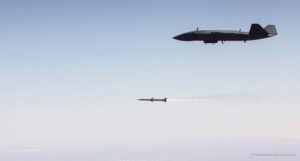
Link-16 Valkyrie. The Marine Corps completed a third successful flight test with the XQ-58A Valkyrie on Sept. 20 at Eglin AFB, Fla. This test, in partnership with the Office of the Under Secretary of Defense for Research and Engineering, Naval Air Warfare Center Aircraft Division, and industry partners demonstrated adding Link-16 capabilities for this uncrewed collaborative combat aircraft (CCA) prototype. The Marine Corps said this was the first time a DoD-controlled air vehicle used offboard expeditionary methods. DoD noted initial results are that the prototype met threshold requirements for autonomously exchanging relevant tactical information. This test was in preparation for the October Emarald Flag 2024 training exercise.
NGJ-MB Upgrades. Naval Air Systems Command awarded RTX’s Raytheon a $192 million contract to cover the design, development, manufacture, integration, demonstration, test, and delivery of a Next Generation Jammer Mid-Band (NJG-MB) extended capability modification. The modification seeks to provide additional frequency coverage to meet more threats within the operational environment for the U.S. Navy and Australia. “With this upgrade, we’ll ensure our naval aviators in all theaters are better prepared to counter new adversary threats and provide greater combat power throughout their missions,” Barbara Borgonovi, president of Naval Power at Raytheon, said in a statement.
LCS-29 Accepted. The Navy accepted delivery of the 15th Freedom-variant Littoral Combat Ship, the future USS Beloit (LCS-29), at the shipbuilder Fincantieri Marinette Marine’s shipyard in Wisconsin. LCS-29 completed acceptance trials in August. After the ship is commissioned, scheduled for later in the year, the Beloit will be homeported with the other Freedom-variant ships in Mayport, Fla. Notably LCS-29 includes a correction for the variant’s combining gear problem that otherwise limits ship speed. The last Freedom-variant ship, the future USS Cleveland (LCS-31), is set to be delivered in 2025.
Saudi AN/TPY-2. RTX’s Raytheon on Sept. 25 said it delivered the first of seven X-band Army Navy/Transportable Radar Surveillance (AN/TPY-2) missile defense radar to Saudi Arabia. In 2020 the Missile Defense Agency awarded the company a $2.3 billion contract for seven AN/TPY_2 radars as part of the Terminal High Altitude Area Defense (THAAD) missile defense system. The company noted this is the first AN/TPY-2 with a complete Gallium Nitride (GaN) populated array in the system, providing greater sensitivity to increase range and surveillance capacity.
DDG-79 To Spain. The Arleigh Burke-class guided-missile destroyer USS Oscar Austin (DDG-79) left Naval Station Norfolk on Sept. 30 to shift its homeport to Naval Station Rota, Spain as part of the Navy’s long-range plan to gradually rotate Rota-based destroyers. DDG-79 is the first of two additional destroyers set to join the current four-ship-strong Forward Deployed Naval Force-Europe (FDNF-E) force. The second ship is set to arrive in 2026 and will be named later. The FDNF-E force began as part of former President Obama’s U.S. European Phased Adaptive Approach for missile defense in Europe.
Shock Barge. Element U.S. Space & Defense launched a new $3 million Extended Floating Shock platform (EFSP) barge on Sept. 18 at its Rustburg, Va., facility. The company said this barge will simulate real-world naval conditions to subject shipboard systems to extreme shocks from rough seas and explosions to verify it meets the Navy’s shock-resistant standards. The company is a government testing partner with NASA, DoD, other government agencies and industry leaders in the defense and space sectors.
Space Logistics. Sierra Space last week said it received a contract from the Air Force Research Laboratory to assess the use of the company’s Sierra Space Ghost, which is basically a pre-positioned container spacecraft to provide payload return capabilities to Earth. The one-year study will look to scale the existing 150-kilogram payload Ghost to accommodate five or 10 metric tons, allowing the launch and return of high material volumes from space in support of global defense logistics, the company said. “The Sierra Space Ghost unlocks scalable point-to-point logistics, transforming the way high-value materiel is transported to disrupted areas when and where it is needed most,” Tom Vice, the company’s CEO, said in a statement.
CBP, TSA Awards. Customs and Border Protection and the Transportation Security Agency each awarded Smiths Detection contracts last week worth a combined $95 million for security detection equipment and support. The four-year award from CBP is worth up to $55.8 million and covers maintenance support and other services related to the company’s radiation detection equipment, and large and small scale non-intrusive inspection systems the agency uses to detect illicit material entering or exiting locations inside and outside the U.S. Under the TSA award, valued at $39.1 million, Smiths Detection will provide its medium-size explosive detection systems used by agency personnel at U.S. airports to automatically scan checked bags for explosives.
New Ramjet Engine. Venus Aerospace last week unveiled its Venus Detonation Ramjet 2,000-pount thrust engine, what it calls VDR2, that it said will “power high-speed vehicles, including drones and aircraft, enabling them to travel vast distances at high altitudes and achieve high-Mach speeds with unmatched efficiency.” Flight testing of the VDR2 will begin in 2025 aboard the company’s hypersonic flight test drone. Venus is taking aim at the commercial and defense sectors with the ramjet engine.
Space Funding. Startup Impulse Space last week announced a $150 million Series B funding round that will be used to grow its current 140 employee talent base and support ongoing production of its Helios and Mira spacecraft to meet upcoming launches. So far, Impulse has raised $225 million from its backers. The latest round was led by Founder Fund and includes returning investors Lux Capital and Spring Tide, and new investor DCVC. Other participants in the round include Airbus Ventures, Alumni Ventures, Balerion Space Ventures, RTX Ventures, Tamarack Global, 137 Ventures, Elysium, First Principles Group, Island Green, Overmatch, and Trousdale Ventures.
…Motion Controls. Salient Motion last week said it raised $12 million in pre-seed and sound rounds as it moves forward on new designs for modular motion control components for aerospace and defense applications. The two-year-old company said its modular actuation systems include a proprietary motion control library that drives electrical efficiency and cost improvements. The funding was led by Carlos Ventures with participation from Andreesen Horowitz, AE Ventures, Hummingbird Ventures, and BoxGroup.
AI Awards. HII last week said its Mission Technologies segment received a task order to conduct research for the Air Force Institute of Technology (AFIT) Autonomy and Navigation Technology Center (ANT) in three areas, including autonomous and cooperative systems, non-GPS precision navigation, and global navigation satellite system navigation/navigation warfare. “The use of autonomy and non-GPS technology to address problems associated with GPS-denied or underground environments, for example, is rapidly evolving, and the ANT Center team is building on a decade of experience to advance AFIT’s mission and find new ways to apply this technology,” HII official Eric Wright said in a statement. The work will be done at Wright-Patterson AFB in Ohio and is being done under the Defense Department’s Information Analysis Center multiple award contract vehicle.
…For Uncrewed Aircraft. Synetos Airspace said it received $1.3 million from the Air Force’s AFWERX innovation arm to refine the company’s MedullOS artificial intelligence-driven software and hardware solution aimed at increasing uncrewed aircraft safety and reducing operator workload. Synetos said the award was made under a Small Business Innovation Research Direct-to-Phase II contract.
Healy Underway. The Coast Guard’s medium polar icebreaker Healy last week left its homeport in Seattle for a months-long Arctic deployment that will include at least three science missions, one for bathymetric mapping in the Chukchi and Beaufort Seas, a second involving multidisciplinary research training for early career polar scientists, and a final one related to sea floor mapping. The fall mission follows the 420-foot vessel having to prematurely return to port in August after an onboard electrical fire cut short Healy’s annual summer mission to the Arctic.
People News. Keith DeVries has joined the Office of the Under Secretary of Defense for Research and Engineering as the new DoD Manufacturing Technology Director, leading efforts to advance and adopt new manufacturing technologies. Previously, he was the deputy director of DoD’s Manufacturing Technology Program, focused on DoD manufacturing capabilities. Rocket developer X-Bow Systems has hired aerospace and defense industry veteran Mike Bender as its chief operating officer. Bender has held business development roles at L3Harris Technologies’ Aerojet Rocketdyne, SpaceX, and the former Orbital ATK. Finally, the private equity firm AE Industrial Partners has appointed retired Navy Rear Adm. Leonard “Butch” Dollaga as managing director. His Navy career includes chief of legislative affairs, supporting the Australia, United Kingdom, and U.S trilateral security initiative called AUKUS, and commander Submarine Group 7 and commander for the Undersea Warfighting Development Center.
Dividend Hike. Lockheed Martin last week announced a 5 percent increase in its quarterly dividend, boosting the per share payout by 15 cents to $3.30. The increase takes effect during the fourth quarter of 2024 and will be paid on Dec. 27. The company said it is the 22nd straight year it has increased its dividend. Lockheed’s board also authorized an additional $3 billion share repurchase, which brings the company’s total repurchase program to about $10 billion.
Aerial Targets. The Army has selected Griffon Aerospace, QinetiQ, KBR, AEVEX Aerospace and COLSA Corp. to compete for orders to provide UAS capabilities as targets under a new $95.1 million contract. The five firms tapped for the Aerial Target Systems 3 (ATS-3) program will provide targets that can be used by the Army and additional Pentagon components. “The term ‘aerial target systems’ includes unmanned aerial targets, unmanned aerial systems, subsystems, components, and other aerial systems and equipment that can be used to replicate aerial threats for use in research, development, test and evaluation and training environments. These systems may be controlled using traditional ground control stations, cellular communication networks, or may operate autonomously,” the Army wrote in its earlier solicitation notice for the ATS-3 effort.
Skydweller UAS. Skydweller Aero on Oct. 1 said it completed the initial autonomous flight test campaign for its Unmanned Aerial System. The series of uncrewed flight tests were launched from Stennis International Airport in Kiln, Miss., and included two lasting for 16 and 22.5 hours, respectively. The campaign began under a Joint Concept Technology Demonstration by the Office of the Undersecretary of Defense for Research & Engineering and sustained via a Cooperative Research & Development Agreement (CRADA) with the Naval Air Warfare Center Aircraft Division (NAWCAD) to evaluate Autonomous Maritime Patrol Aircraft (AMPA). The company is developing a fleet of the largest solar-powered uncrewed aircraft to perform extremely long endurance flight with heavy payloads.
Stratospheric UAS. AeroVironment announced on Oct. 1 it has flight tested an upgraded version of its Sunglider solar-powered stratospheric UAS, called the Horus A, with plans for “aggressively progressing” the capability “toward operational employment. “During this recent Horus A flight, we demonstrated the ability to carry multiple payloads for the U.S. DoD and transmit real-time data, advancing the viability of [High-Altitude Platform-Station] (HAPS) for government applications,” Jeff Rodrian, senior vice president and general manager of AeroVironment’s MacCready Works, said in a statement. “This flight marks another milestone in our stratospheric platform’s progress. It underscores AV’s leadership in developing solar-powered, high-altitude systems with significant potential for commercial and government applications.” AeroVironment noted the recent stratospheric flight test with the Horus A UAS was supposed by the Pentagon’s Office of the Under Secretary of Defense for Research and Engineering.
New DISA Director. Army Lt. Gen. Paul Stanton on Oct. 4 assumed command of the Pentagon’s Defense Information Systems Agency. Stanton, who was most recently commanding general of the U.S. Army Cyber Center of Excellence, succeeds Air Force Lt. Gen. Robert Skinner, who has held the dual-hatted post of DISA Director and commander of Joint Force Headquarters–Department of Defense Information Network since 2021. “We are in an unprecedented period of significant change in an unsettled world that has an insatiable appetite for data,” Stanton said in a statement. “At the core of our responsibilities, we must securely and reliably get the right data to the right place at the right time to make a better and faster decision than our enemies, period. This is our business. This is warfighting as it has been, it is today and will be in the future. This agency and command are critical to our nation’s warfighting success. Failure is not an option, and excellence is our standard.”