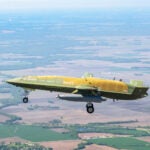
The Navy's effort to develop an aircraft carrier based unmanned combat aircraft system (UCAS) is absolutely critical to the service, but the Navy must demonstrate that the system can be safely integrated onto a ship and it must have the support of congress and the Pentagon for UCAS to survive, according to the Center for Strategic and Budgetary Assessments (CSBA). The Navy's Unmanned Combat Air System-Demonstrator (UCAS-D) and the eventual follow-on, Navy (N)-UCAS, face a rough road, according to CSBA's…
Recommended
Media Gaggle With Lt. Col. Alex Morse, Capability Manager for Mobile Solutions at Joint Interagency Task Force-401
Trending
Congress Updates
House Republicans’ Blueprint For Reconciliation 3.0 Includes $60 Billion For Defense
House Republicans on Wednesday unveiled a blueprint for a third reconciliation bill that includes $60 billion for defense, a figure slightly below the Trump administration’s request to cover Iran war […]
Senate Dems Block Consideration Of FY ‘27 NDAA Over Iran War Concerns
Senate Democrats on Tuesday blocked a vote to advance consideration of the chamber’s $1.14 trillion fiscal year 2027 National Defense Authorization (NDAA). The procedural vote was 46-50, failing to reach […]
Concerns Raised At SASC Hearing On Unobligated Reconciliation Funds And Lack Of Updates On Iran War Cost
Members of the Senate Armed Services Committee (SASC) raised concerns at a hearing on Tuesday about the majority of funds in the $153 billion first reconciliation bill being unobligated thus […]
CBO Says Upfront Costs To Protect Military Installations From Drones Between $1 Million And $74 Million
The initial costs to acquire and deploy counter-small unmanned aircraft system (C-sUAS) defenses at individual Defense Department installations are estimated at between $1.2 million and $73.6 million depending on the […]